← Blog · Profiles
Four Nobel Prizes for AI in one year. Who got them and why?
 Ayushman Dash · November 27, 2025 · 3 min read
The 2024 Nobel Sweep: How AI Conquered Physics and Chemistry
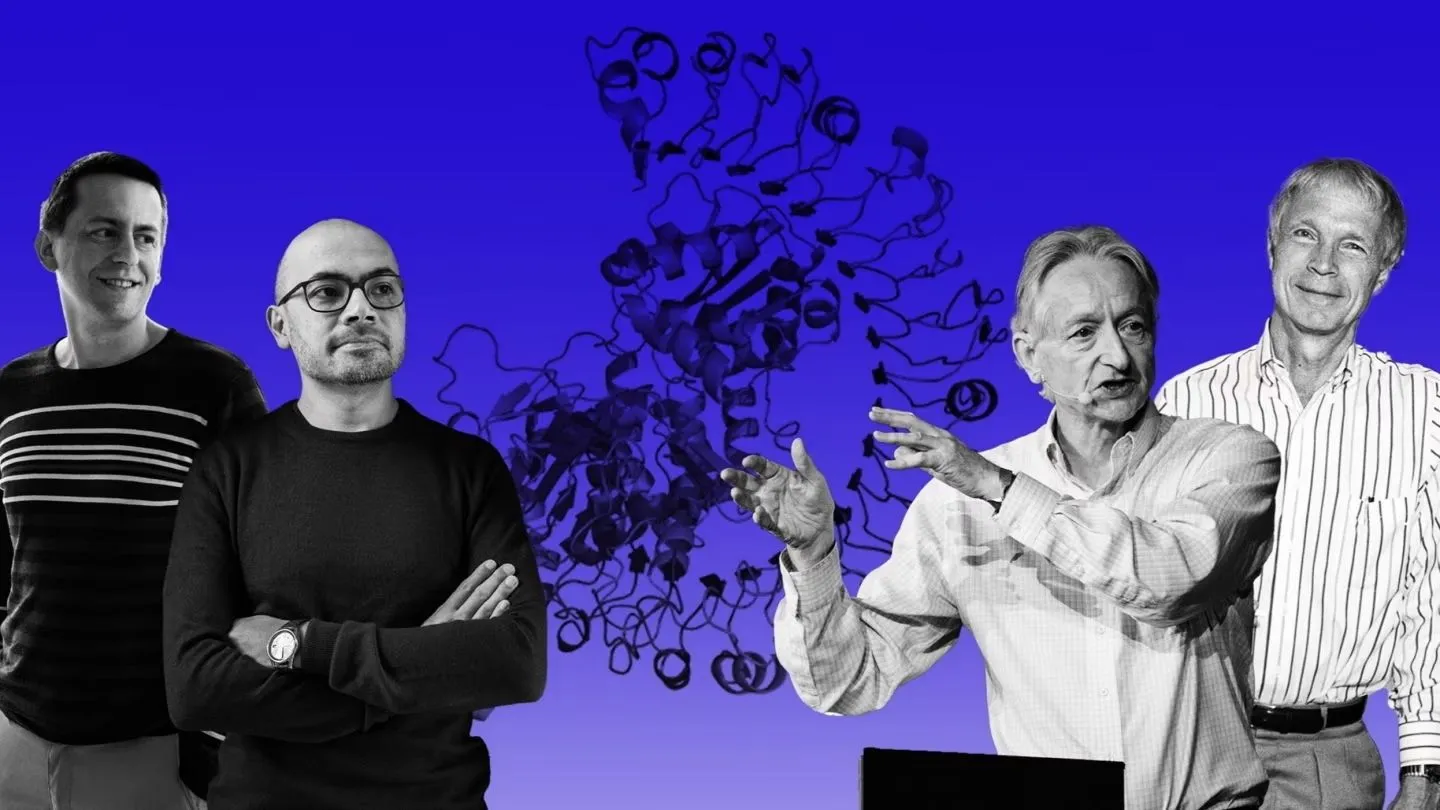
2024 will likely be remembered as the year the scientific establishment officially embraced Artificial Intelligence. In an unprecedented move, the Royal Swedish Academy of Sciences awarded four Nobel Prizes to researchers working directly in AI.
It wasn’t four separate categories. It was four individuals, across two distinct scientific fields, all recognized for a single transformative technology.
Two winners in Physics. Two winners in Chemistry.
Here is a breakdown of who won, what they discovered, and why 2024 was the year AI took the spotlight.
The Physics Nobel: Building the “Digital Brain”
The Winners: John Hopfield and Geoffrey Hinton
The Nobel Prize in Physics is traditionally reserved for discoveries about the physical universe, atoms, light, and gravity. However, this year, the committee recognized the mathematical foundations of the digital universe.
The official citation credited Hopfield and Hinton for “foundational discoveries and inventions that enable machine learning with artificial neural networks.” But what does that actually mean?
John Hopfield: Associative Memory
John Hopfield is credited with creating the “Hopfield Network.” He demonstrated how a network of simple units could store and recall patterns.
Think of it like a human brain that sees only half of a photograph but can mentally fill in the rest. Hopfield applied concepts from physics (specifically regarding energy states) to show how a computer could reconstruct a complete pattern from incomplete data.
Geoffrey Hinton: The Godfather of AI
Building on Hopfield’s work, Geoffrey Hinton developed new methods for these networks to teach themselves. He created algorithms that allowed machines to recognize underlying structures in data independently.
Hinton’s work sparked the Deep Learning revolution. Without his contributions, the modern AI tools we use today, from ChatGPT to image generators, would not exist.
The Takeaway: Physics rewarded them for engineering the mathematical brain behind modern AI.
The Chemistry Nobel: Decoding the Language of Life
The Winners: Demis Hassabis and John Jumper
While the Physics prize honored the theory behind AI, the Chemistry prize honored a groundbreaking application. Demis Hassabis and John Jumper (both from Google DeepMind) received the award for AlphaFold.
The Problem: Protein Folding
Proteins are the tiny biological machines that drive almost every process in your body. Their function is determined by their 3D shape. For 50 years, predicting how a protein would fold into that shape was one of the hardest problems in biology. It was slow, painful, and expensive science.
The Solution: AlphaFold
Hassabis and Jumper didn’t just improve the process; they solved it. They trained an AI system, AlphaFold, to predict the 3D structure of almost all known proteins.
This breakthrough has already accelerated research in:
- Drug discovery: Designing new medicines faster.
- Biology: Understanding diseases at a molecular level.
- Sustainability: Designing enzymes to break down pollutants.
The Takeaway: Chemistry rewarded them for using AI to read and understand the fundamental language of life.
Summary: Theory Meets Application
The story of the 2024 Nobel Prizes is the story of AI’s maturation.
- The Physics Prize said: “These two men built the core ideas that made AI brains possible.”
- The Chemistry Prize said: “These two men used those brains to crack a 50-year-old problem in biology.”
From the theoretical foundations laid by Hopfield and Hinton to the practical, world-changing application by Hassabis and Jumper, the message is clear: AI is no longer just a computer science topic. It is a fundamental layer of modern science.
Hopfield. Hinton. Hassabis. Jumper.
Four prizes in one year, and this is likely just the beginning.
Read More on AI with Ayushman
If you enjoyed this deep dive into the titans of AI history, you might also like these articles from the blog:
- Aakanksha Chowdhery: A lesser-known titan of the world of AI – Meet the engineer behind Google’s massive PaLM models.
- Every AI team hits a wall. Ours had ‘RAG’ written all over it. – A practical look at the engineering challenges of modern AI.
- 5 Prompts That Will Help You Crack Any AI Interview – Prepare for your own career in the industry.